Written and medically reviewed by: Dr. Prratyush More, MBBS, DDVL| Roots Restore, Thane
.
If you have started noticing a wider parting, a thinner crown or more scalp under bright light, you have probably come across three terms: PRP, GFC and exosomes. They are often discussed together, as if they were three versions of the same thing. They are not. They come from different sources, the research behind each is at a very different stage, and none of them is the right choice for everyone.
This article explains what each treatment is, what the current evidence does and does not support, and how the stage and cause of your hair loss affect whether any of them is likely to help.
| In brief
• All three are add-on treatments. They work best alongside proven medical treatment, not instead of it. • They can only act on hair follicles that are still alive. They cannot regrow hair on areas that have been smooth and bald for years. • PRP has the most research behind it. GFC is a variation of PRP with fewer studies. Exosome treatment for hair is still at an early, largely experimental stage. • The first step is always a diagnosis: finding out why your hair is thinning. |
First, why “stage” matters
The most common cause of gradual thinning in adults is androgenetic alopecia, also called male or female pattern hair loss. Each hair follicle cycles through a growth phase (anagen, lasting several years on the scalp), a short transition phase (catagen) and a resting phase (telogen), after which the hair sheds and a new one starts. In androgenetic alopecia, a genetic sensitivity of the follicle to androgens, particularly dihydrotestosterone (DHT), gradually shortens the growth phase.
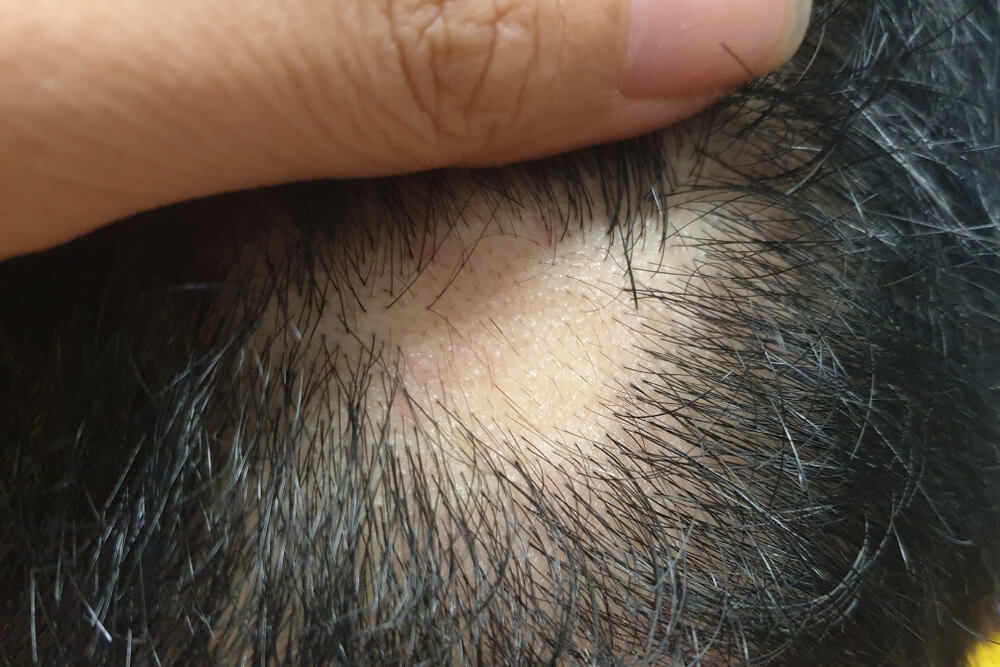
As a result, affected follicles slowly shrink. This is called miniaturisation. Each new hair grows a little finer and shorter than the last, until eventually some follicles stop producing visible hair. On trichoscopy, a dermatologist sees this as variation in hair shaft thickness, with more thin hairs mixed among thick ones.
Dermatologists describe how far this has progressed using grading scales: the Hamilton–Norwood scale for men (from mild recession at the temples to extensive baldness on top) and the Ludwig or Sinclair scales for women (from a slightly wider central parting to marked thinning over the top of the scalp).
Stage matters because PRP, GFC and exosome treatments are thought to support follicles that are weakening but still present. They may help a miniaturised follicle produce a thicker hair. They cannot create new follicles where they have already been lost. In general, the earlier the stage, the more there is to work with.
It is also important to know that not all thinning is pattern hair loss. Sudden shedding after an illness, thyroid problems, low iron stores, alopecia areata and scarring hair loss conditions can all look like “thinning”. These need a different approach, so a proper examination, often with trichoscopy (a magnified scalp examination) and sometimes blood tests, should come before any procedure.
PRP (platelet-rich plasma)
What it is
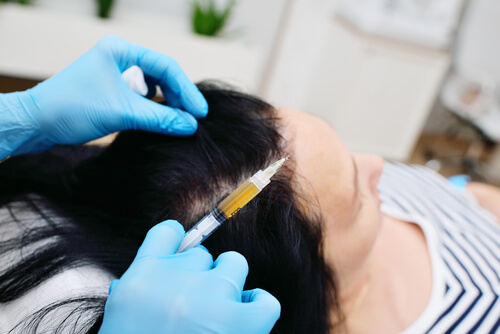
A small amount of your own blood is drawn and spun in a centrifuge to separate out a portion rich in platelets. This platelet-rich plasma is then injected into the thinning areas of the scalp. Platelets release growth factors, such as PDGF, VEGF, EGF and IGF-1. In laboratory studies, these support the cells at the base of the follicle and the blood supply around it, and are thought to help prolong the growth phase.
What the evidence says
PRP is the most studied of the three. A 2024 systematic review and meta-analysis of randomised trials found that, on average, PRP increased hair density compared with placebo in androgenetic alopecia. However, the authors rated the certainty of this evidence as low, because the studies were small, used different preparation methods and produced widely varying results. Reviews also suggest PRP may add some benefit when combined with topical minoxidil.
In practical terms, PRP can produce a modest improvement, mostly in early to moderate stages. Results differ partly because there is no single standard way of preparing PRP (platelet concentration, activation method, number and spacing of sessions all vary), and partly because people respond differently.
What it typically involves
- An initial course of several sessions, usually spaced about a month apart, followed by maintenance sessions. Any benefit tends to fade if treatment stops.
- Common side effects include discomfort during injections, temporary redness, swelling, tenderness and headache. Infection is uncommon.
- It may not be suitable for people with low platelet counts or other blood disorders, those on certain blood-thinning medicines, those with an active scalp infection, or people with some other medical conditions. Your doctor will check this.
GFC (growth factor concentrate)
What it is
GFC is also prepared from your own blood, but it is processed differently. The platelets are activated in a tube so that they release their growth factors before injection, and the resulting concentrate is injected with most of the cells removed. It is sometimes described as more concentrated or more comfortable than PRP.
What the evidence says
There are fewer studies on GFC, and many are small or from single centres. There is limited high-quality research directly comparing GFC with well-prepared PRP. At present, it is reasonable to think of GFC as a variation of PRP rather than a treatment proven to work better. Who it may suit, how it is given and who should avoid it are broadly similar to PRP.
Exosomes
What they are
Exosomes are tiny particles released by cells. They carry proteins and genetic material that cells use to signal to one another. Unlike PRP and GFC, exosome products used for hair are not taken from your own body. They are usually derived from cells grown in a laboratory (for example, stem cells from umbilical cord or fat tissue) or, in some products, from plant sources. They are typically applied after microneedling or injected into the scalp.
What the evidence says
This is the newest of the three and the least established. Laboratory and animal studies have produced interesting results, but human studies so far are small, short-term and often without a comparison group. Products vary widely in their source, purity and concentration, so a result with one product cannot be assumed for another.
A 2024 review in the Journal of Drugs in Dermatology concluded that research in humans is limited and called for standardised studies to establish how exosomes work, whether they are safe and how well they work.
Regulatory status is also an open question. The US Food and Drug Administration (FDA) states that there are currently no FDA-approved exosome products, and has issued consumer alerts about unapproved products marketed for various conditions. If exosome treatment is suggested to you, it is reasonable to ask exactly which product will be used, where it comes from, and what its approval status is in India. Because these products come from donor cells, questions about long-term safety have not yet been fully answered.
An honest summary: exosomes are a promising area of research, not yet an established treatment. If you choose it, it should be an informed decision, made with a clear understanding of what is still unknown.
The three side by side
| PRP | GFC | Exosomes | |
| Source | Your own blood | Your own blood, processed differently | Laboratory-grown donor cells or other sources |
| Strength of evidence | Most studied; modest benefit in early to moderate pattern hair loss | Limited; fewer and smaller studies | Early; few controlled human studies |
| Usual role | Add-on to medical treatment | Alternative to PRP | Experimental or add-on |
| A good question to ask | How is it prepared, and how many sessions plus maintenance? | What evidence supports this specific method? | Which product, from what source, and what is its approval status? |
Matching options to your stage: a general guide
The points below are a general framework, not a rule. Your dermatologist will consider your age, the cause of hair loss, how fast it is changing, your medical history and your goals.
Early thinning
A slightly wider parting, a little recession or finer hair, with hair still covering the scalp (roughly Norwood 2–3 or Ludwig stage I). This is generally the best time to start treatment. The foundation is usually medical treatment, which has the strongest evidence in international guidelines: topical minoxidil for men and women, finasteride for men, and in selected patients, low-dose oral minoxidil or (for some women) anti-androgen medicines under supervision. Medical treatment typically needs 4 to 6 months before any change is visible, and an initial increase in shedding in the first weeks of minoxidil is common and usually temporary. PRP may be discussed as an add-on.
Moderate thinning
Scalp is clearly visible in some areas, but fine, miniaturised hairs are still present (roughly Norwood 3–4 or Ludwig stage II). Medical treatment remains the base. PRP or GFC may help maintain and modestly improve density where miniaturised hairs remain. A realistic expectation is some improvement in thickness and coverage, not a return to how your hair looked years ago.
Advanced thinning
Large smooth areas with few or no hairs left (roughly Norwood 5 and above, or Ludwig stage III). Injection-based treatments on their own are unlikely to bring hair back to areas without follicles. Discussion usually turns to medical treatment to protect the hair that remains and, where the donor area allows, hair transplantation. Scalp micropigmentation and hair systems are other options some people consider.
When the cause is something else
If the hair loss is due to shedding after illness, a thyroid problem, a nutritional deficiency or alopecia areata, treating the cause comes first. In many of these situations, procedures may not be needed at all.
What none of these treatments can promise
- They do not stop pattern hair loss on their own. It is a long-term, progressive condition that usually needs ongoing medical treatment.
- They do not work for everyone. Some people notice a clear improvement; others notice little change.
- Their effects are not permanent. Maintenance is usually needed to keep any benefit.
- They do not replace a diagnosis. Treating the wrong cause wastes time and money.
Questions worth asking before you start
- What is causing my hair loss, and what stage is it at?
- What is the first-line treatment for my type of hair loss, and am I already using it correctly?
- Why is this procedure being suggested for me specifically?
- How will we measure whether it is working, for example with standardised photographs or trichoscopy?
- How many sessions are planned, and what maintenance will I need afterwards?
- What side effects should I expect, and is there any reason it may not be safe for me?
- For exosomes: which product will be used, what is its source, and what is its regulatory status?
When to see a dermatologist
- You are shedding much more hair than usual, or your parting or crown is visibly thinner.
- You notice round bald patches, or hair loss along with itching, pain, redness or scaling of the scalp.
- Hair thinning comes with irregular periods, acne or increased facial hair.
- You have a strong family history of hair loss and are noticing early changes.
Important note
This article is for general health education only. It is not a substitute for an in-person consultation, diagnosis or treatment. The suitability and results of any treatment vary from person to person, and no treatment can promise a particular outcome. Please consult a qualified Registered Medical Practitioner about your own situation.
References
- Kanti V, Messenger A, Dobos G, et al. Evidence-based (S3) guideline for the treatment of androgenetic alopecia in women and in men – short version. J Eur Acad Dermatol Venereol. 2018;32(1):11–22.
- Kieling L, Konzen AT, Zanella RK, Valente DS. Is autologous platelet-rich plasma capable of increasing hair density in patients with androgenic alopecia? A systematic review and meta-analysis of randomized clinical trials. An Bras Dermatol. 2024;99(6):847–862.
- Buontempo MG, Alhanshali L, Ide M, Shapiro J, Lo Sicco K. Examining the uncertainties surrounding exosome therapy in androgenetic alopecia: a call for evidence-based practice. J Drugs Dermatol. 2024;23(3):e86–e90.
- US Food and Drug Administration. Consumer Alert on Regenerative Medicine Products Including Stem Cells and Exosomes. Updated April 2024.