Written and medically reviewed by: Dr. Prratyush More, MBBS, DDVL| Roots Restore, Thane
You had a round bald patch. You were treated, the hair grew back, and then, months later, another patch appeared somewhere else. It is easy to feel that the treatment failed or that something was missed. Understanding what alopecia areata is explains why this happens so often, and what you can reasonably expect from treatment.
| In brief
• Alopecia areata is an autoimmune condition. The hair follicle is attacked but not destroyed, so hair can grow back. • Treatment can calm the attack on current patches and speed regrowth, but it does not switch off the underlying tendency. New patches can appear later. • Relapses are common and do not mean the earlier treatment was wrong. • Be cautious of any promise of a “permanent cure”. |
What alopecia areata is
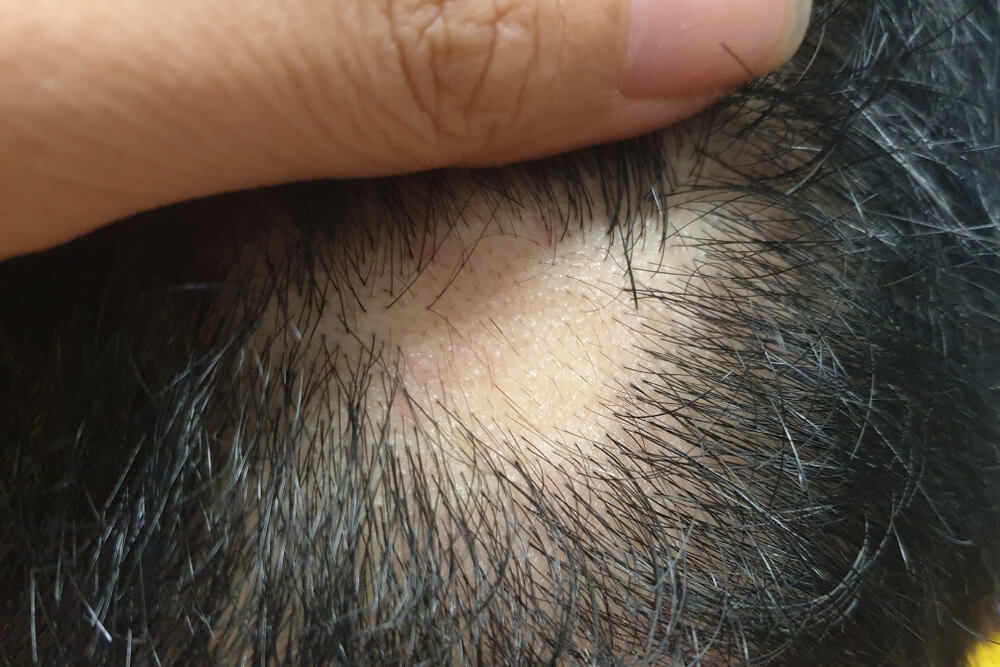
Healthy growing hair follicles normally enjoy a degree of “immune privilege”: they are partly hidden from the immune system. In alopecia areata, this protection breaks down. Immune cells, particularly CD8+ T cells, gather around the base (bulb) of growing follicles and release signalling molecules such as interferon-gamma, which act through a pathway inside cells called JAK-STAT. The follicle is pushed out of its growth phase, and the hair falls out, usually in smooth, round or oval patches.
The key point is that the follicle itself is not scarred or destroyed. Its stem cells are spared, so it goes into a kind of protective pause, which is why hair can regrow, sometimes even without treatment. On trichoscopy, dermatologists look for typical signs such as yellow dots, black dots, broken hairs and short “exclamation mark” hairs, which narrow towards the scalp and suggest the patch is active.
It can affect the scalp, beard, eyebrows, eyelashes and body hair. Some people also notice small pits or ridges on their nails. The condition has several patterns:
- Patchy alopecia areata: one or more separate patches. This is the most common form.
- Ophiasis pattern: hair loss in a band along the sides and back of the scalp.
- Alopecia totalis: loss of all or nearly all scalp hair.
- Alopecia universalis: loss of hair from the scalp and body.
Why the patches keep coming back
Treatment works on the immune activity at the patches that are active right now. It does not change the underlying tendency of the immune system to target hair follicles. That tendency is shaped largely by genetics, and it can become active again at any time.
Sometimes a new episode follows an illness or a stressful period, but often there is no identifiable trigger at all. This is not something you caused. Many people with patchy alopecia areata have more than one episode over their lifetime, and the course is genuinely unpredictable: some people have a single episode and never another, while others have repeated episodes over years.
It is also worth knowing that limited, patchy disease often improves on its own. Long-term follow-up studies have estimated that roughly a third to a half of people with patchy alopecia areata regrow within a year of onset without treatment. Spontaneous regrowth is much less likely in extensive disease: a 2025 meta-analysis of placebo groups in clinical trials, which mostly included people with severe hair loss, found that only a small minority regrew substantially without active treatment. This is one reason treatment decisions depend so much on the extent of hair loss.
What treatment can do
The goals of treatment are to calm the immune attack on active patches, encourage regrowth and, in more extensive disease, try to keep hair coverage stable. Options are chosen based on how much hair is affected, how quickly it is changing, your age and your overall health. Dermatologists often measure scalp involvement with the SALT score (Severity of Alopecia Tool), which estimates the percentage of scalp hair lost and helps track response over time.
For limited patches
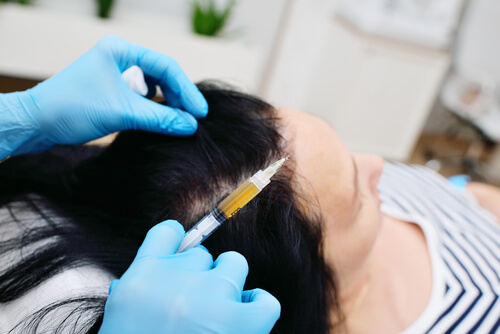
- Corticosteroid injections into the patch (intralesional steroids): a common first-line treatment for limited patches in adults. Regrowth, if it occurs, usually starts within several weeks. Possible side effects include temporary thinning or denting of the skin at the injection site.
- Strong topical steroid creams or lotions: often used in children or alongside other treatments.
- Topical minoxidil: sometimes used as an add-on to support regrowth.
For extensive or rapidly spreading disease
- Short courses of oral or pulse steroids: may be used to slow rapid spread. Side effects limit how long they can be used.
- Topical immunotherapy: a chemical applied to the scalp to create a mild, controlled skin reaction that can redirect the immune response. Offered in some specialist centres.
- Other immune-modulating medicines, such as methotrexate or ciclosporin, in selected cases.
- JAK inhibitors: oral medicines that block the JAK-STAT signalling pathway that drives the immune attack on the follicle. In the United States, three have been approved for severe alopecia areata: baricitinib (adults from 2022, and adolescents 12 and over from September 2026), ritlecitinib (12 and over, 2023) and deuruxolitinib (adults, 2024). In clinical trials, a meaningful proportion of patients with severe disease regained most of their scalp hair within about a year, but not everyone responds. They require a specialist’s assessment, regular blood tests and monitoring for side effects such as infections. Hair often falls out again if they are stopped. Your dermatologist can advise whether they are available and appropriate for you.
Support beyond medicine
Wigs, hair toppers, brow pencils, scarves and hats are valid choices, not a sign of giving up. Many people use them alongside treatment or instead of it.
What treatment cannot promise
- A cure. At present, there is no treatment that permanently removes the tendency to develop alopecia areata.
- That no new patches will appear. Relapse is part of the natural course for many people.
- The same response every time. A treatment that worked well once may work less well in a later episode, or the reverse.
- Fast results. Hair grows slowly. Most treatments take weeks to months to show a response.
- That regrown hair will look the same straight away. New hair often comes in fine and white or grey at first, then gradually thickens and regains its colour.
Factors linked to more persistent disease
Long-term follow-up studies and expert reviews have identified several features associated with a more long-lasting or extensive course. These are tendencies, not certainties:
- Extensive hair loss, or loss of all scalp hair
- The ophiasis pattern
- Onset in childhood
- A long duration of the current episode
- Nail changes
- A personal or family history of eczema, asthma or other autoimmune conditions
Related health checks
Alopecia areata is more common in people who have, or have a family history of, thyroid disease, vitiligo, atopic conditions such as eczema and asthma, and some other autoimmune conditions. Depending on your history and examination, your doctor may suggest blood tests such as thyroid function. Not everyone needs every test.
What to do when a new patch appears
- Note the date and approximate size, and take a clear photo for your own record. This helps your doctor judge how it is changing.
- Check your eyebrows, eyelashes, beard area and nails as well.
- See your dermatologist early. Treating an active patch promptly may help, and early review helps spot faster-spreading disease.
- Avoid harsh home remedies that irritate the scalp. Irritation does not treat alopecia areata and can make the skin sore.
- Do not restart old prescription creams or medicines without checking with your doctor first.
The emotional side
Hair loss that comes and goes unpredictably can be very hard to live with. Anxiety, low mood and self-consciousness are common, especially in teenagers and young adults. Talking to your doctor about how it is affecting you is part of good care. Counselling and patient support groups help many people. If a child is affected, a word with their school can make a real difference.
Important note
This article is for general health education only. It is not a substitute for an in-person consultation, diagnosis or treatment. The suitability and results of any treatment vary from person to person, and no treatment can promise a particular outcome. Please consult a qualified Registered Medical Practitioner about your own situation.
References
- Strazzulla LC, Wang EHC, Avila L, et al. Alopecia areata: disease characteristics, clinical evaluation, and new perspectives on pathogenesis. J Am Acad Dermatol. 2018;78(1):1–12.
- Strazzulla LC, Wang EHC, Avila L, et al. Alopecia areata: an appraisal of new treatment approaches and overview of current therapies. J Am Acad Dermatol. 2018;78(1):15–24.
- Tosti A, Bellavista S, Iorizzo M. Alopecia areata: a long term follow-up study of 191 patients. J Am Acad Dermatol. 2006;55(3):438–441.
- Jastrząb-Miśkiewicz B, Szepietowski JC, Saceda Corralo D, Krajewski PK. Is spontaneous regrowth in alopecia areata possible? A systematic review and meta-analysis of placebo-controlled studies. Acta Derm Venereol. 2025;105:adv44153.
- Meah N, Wall D, York K, et al. The Alopecia Areata Consensus of Experts (ACE) study: results of an international expert opinion on treatments for alopecia areata. J Am Acad Dermatol. 2020;83(1):123–130.
- National Alopecia Areata Foundation. FDA-approved JAK inhibitors for alopecia areata. Accessed October 2026.