Medically reviewed by Dr Prratyush More, MBBS, MD/DNB (Dermatology, Venereology & Leprology)
Summary: Recovery follows a predictable pattern. Swelling peaks around day 3 and settles by day 7, scabs shed over the first ten days, and transplanted hairs shed between weeks two and four. A second, larger wave of shedding — this time affecting your own existing hair
— peaks around months two to three, and this is the phase patients find hardest. It is normal. The follicle survives in both cases. Gentle washing, leaving scabs alone, sun protection, and continuing medical treatment for ongoing hair loss are what most affect the final result, which is not assessable until twelve to eighteen months.
The surgery is only half the outcome. How the scalp is washed, whether scabs are left alone, how sun and sweat are managed, and whether medical treatment continues all shape the final result.
Here is the timeline, and — just as importantly — what falls outside it and should prompt a phone call.
Days 1 to 3: Protecting the Grafts
The first days are about managing swelling and protecting grafts while they establish a blood supply.
Mild swelling around the forehead and hairline usually appears within the first two days and peaks around day 3. It commonly travels downwards over the forehead and around the eyes before settling. This looks alarming and is harmless.
Sleep with your head elevated, at roughly 45 degrees, for the first several nights — a recliner or a stack of pillows with a neck pillow works well. Keep the recipient area off the pillow.
Do not touch or scratch the transplanted area. Grafts are at their most vulnerable in the first 72 hours, but caution should continue for around ten days rather than stopping at day three.
Other points for this window:
- Avoid aspirin and anti-inflammatory painkillers unless your surgeon specifies
otherwise, because of bleeding risk. Paracetamol is usually the recommended option.
- No smoking and no Smoking constricts blood vessels and impairs graft survival; alcohol increases bleeding and swelling. Most surgeons advise avoiding both for at least two weeks either side of the procedure.
- No bending, straining or heavy
Washing is usually withheld for the first day or two, then replaced by a prescribed gentle method rather than your normal shampoo routine.
Days 4 to 7: Early Healing and the First Washes
Swelling generally begins subsiding by day 5, and by day 7 most redness and swelling has noticeably reduced.
Gentle washing begins in earnest — typically a mild foam or lotion applied to soften scabs, then rinsed by pouring rather than direct spray or shampoo pressure.
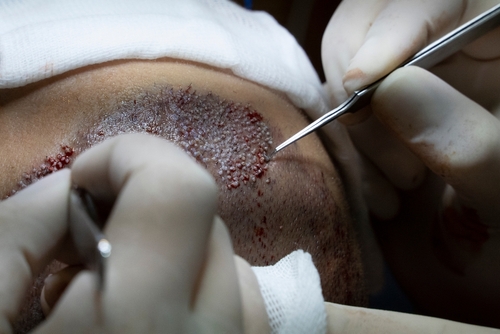
Scabs will be visible around each graft. This is normal. Do not pick or scratch them: disturbing a scab before it is ready risks dislodging the graft underneath.
Most patients return to light daily activity by the end of the first week. Heavy exercise, swimming, saunas, steam rooms, very hot showers and direct sun exposure all still need to wait.
A practical point often left out: avoid tight caps and helmets. If you ride a two-wheeler, discuss timing with your surgeon rather than assuming a helmet is fine — a loose hat is usually permitted from around day 5 to 7.
Days 8 to 14: Scabs Shed, Donor Area Settles
Scabs typically fall away naturally through the second week. Mild itching or a tight sensation is common as tissue settles. Temporary numbness or odd sensation in the donor and recipient areas is also normal and resolves over weeks to months.
Keep resisting the urge to scratch. This is a higher-risk period precisely because the scalp begins to feel normal again. A cool compress near, not on, the grafts, or a prescribed saline spray, helps more safely.
Donor area care depends on the technique used, which most aftercare guides gloss over. FUE extraction sites generally close over roughly seven to ten days. With FUT, a strip closure means sutures or staples are usually removed around day ten to fourteen, and the area needs more care around tension on the scar.
Sun protection matters throughout. Freshly healed skin is highly UV-sensitive, and sunburn at this stage genuinely affects healing. Use a hat rather than applying sunscreen directly onto fresh grafts.
Weeks 2 to 4: The First Shedding Wave
Between the second and fourth week, most patients see transplanted hairs begin to shed. Nearly all transplanted follicles shed their shafts during this phase.
The mechanism is straightforward: during extraction and implantation, follicles are briefly cut off from their blood supply, and that stress causes the hair shaft to detach. The follicle itself remains alive beneath the scalp. Only the visible shaft is lost.
The comparison that helps most patients is a plant moved to a new pot: it drops its leaves while the roots stay intact.
Months 2 to 3: The Part Most Guides Leave Out
This is the correction that matters most, because a guide that stops at one month leaves patients unprepared for the harder phase.
The shedding at weeks two to four and the shedding that follows are two different mechanisms on different timelines. Most patient-facing content conflates them, and that confusion is a major source of unnecessary anxiety.
The second wave is a stress-driven telogen effluvium that peaks around months two to three, and it affects your existing native hair in the recipient area — not just the transplanted grafts. It can also affect the donor area, showing up as thinning at the back or sides, which patients often misread as over-harvesting.
This is the point where density can look worse than before surgery. It is also, medically, expected. The International Society of Hair Restoration Surgery is explicit that shedding alone does not indicate graft failure — the shaft sheds while the follicle survives. Native hairs recover in the large majority of cases, though hairs that were already miniaturised before surgery may need ongoing medical treatment to come back.
The full timeline is worth having in advance:
- Weeks 2–4: transplanted shafts shed
- Months 2–3: the low point, as native and transplanted hair shed together
- Months 3–6: new growth emerges
- Months 6–12: noticeable thickening
- Months 12–18: final result
The Thing Aftercare Guides Rarely Mention: Ongoing Treatment
A transplant relocates hair. It does not stop the process that caused the hair loss.
Without ongoing medical treatment for androgenetic alopecia, native hair around and behind the transplanted area continues to recede, which over several years can leave a transplanted hairline sitting in front of a thinning zone. This is one of the commonest reasons a technically good transplant looks unnatural later.
Finasteride and topical minoxidil are the usual mainstays. Minoxidil is typically restarted around two weeks after surgery, but timing varies by surgeon, so follow your specific instruction rather than a general rule.
What to Avoid Through the First Month
- Picking, scratching or forcefully washing the scabbed area
- Direct, unprotected sun on the scalp
- Heavy exercise, swimming, sauna, steam and heavy sweating until cleared
- Tight hats and helmets
- Smoking and alcohol
- Clippers or razors on the recipient area, and hair dye, for about a month; scissors are usually fine sooner
- Panicking about shedding at weeks 2–4 or months 2–3
When to Call Your Surgeon
Aftercare guides tend to describe only the normal course. These are the things that fall outside it and warrant prompt contact:
- Fever, or spreading redness and warmth across the scalp
- Pus, or foul-smelling discharge from graft or donor sites
- Pain that increases after day three rather than easing
- Bleeding that does not stop after fifteen minutes of gentle, steady pressure
- Clusters of pimple-like bumps around grafts — post-operative folliculitis is common between weeks two and eight and is treatable, but should be assessed rather than squeezed
- A graft that visibly comes away, particularly in the first few days
- Numbness that is worsening rather than gradually improving
Frequently Asked Questions
When does swelling go away? It typically peaks around day 3 and subsides by day 5 to 7. It often moves down the forehead and around the eyes first, which is normal. Sleeping elevated limits how much develops.
Is it normal for transplanted hair to fall out? Yes, and nearly all of it does, usually between weeks two and four. The shaft sheds while the follicle stays alive.
My own hair is falling out too — is that normal? Usually yes. Existing native hair around the recipient site, and sometimes in the donor area, can shed as a delayed stress response peaking around months two to three. It regrows in the large majority of cases.
When can I wash normally? A prescribed gentle method for the first ten days or so, moving to normal washing once scabs have fully shed, generally around two weeks.
When can I exercise again? Light activity within the first week. Heavy exercise, swimming and anything causing significant sweating generally wait two to four weeks, on your surgeon’s guidance.
When will I see results? New growth generally starts around month three or four, becomes noticeable by six to twelve months, and the final result is assessed at twelve to eighteen months.
Do I still need medication after a transplant? Usually yes. A transplant does not halt ongoing hair loss in untransplanted areas, so continuing medical treatment protects the long-term appearance of the result.
Aftercare Guidance in Thane
By the end of the first month the scalp has usually healed visibly and scabs are gone, but the shedding phase is still unfolding and visible growth has not begun. The first month is about protecting the work, not judging it.
Every patient should receive a detailed, personalised aftercare plan at the time of the procedure, along with a direct route to the clinic for anything that comes up during recovery
— particularly during the months two to three dip, when reassurance matters most.
If you are preparing for a procedure, book a consultation with Roots Restore for an aftercare plan built around your case and technique.
This article is for general information and does not replace individual medical advice or your surgeon’s specific post-operative instructions, which take precedence.