
Summary
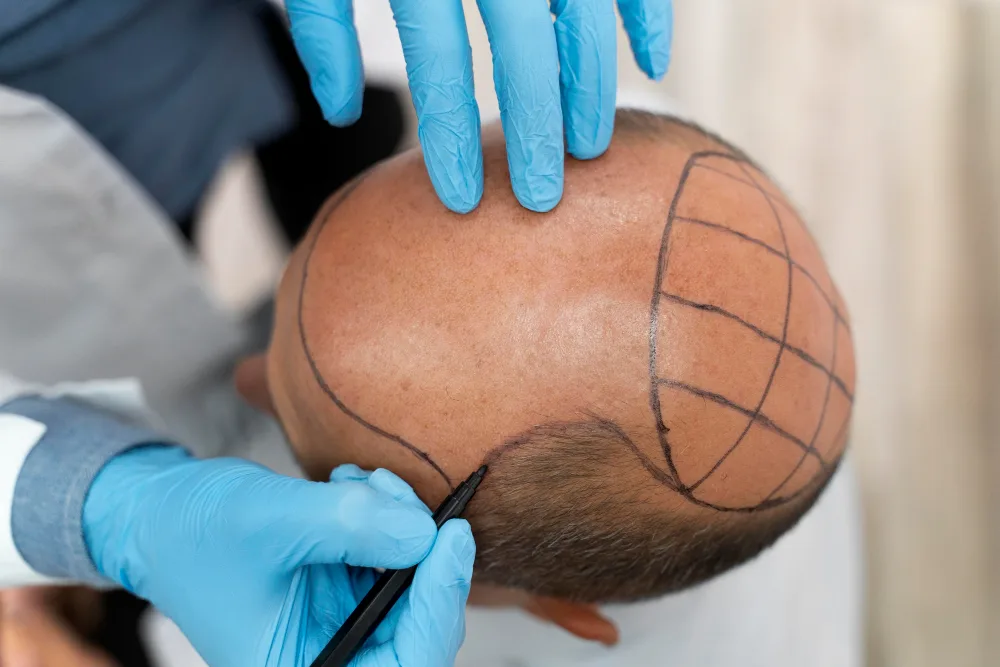
Stage 7 baldness is the most advanced form of male-pattern hair loss. The top is usually bald, with a narrow horseshoe band left at the sides and back. A hair transplant may still be possible, but full coverage is rarely realistic. The result depends on donor hair, scalp health, and realistic goals. In Thane and Mumbai, ROOTS RESTORE offers surgeon-led FUE planning, transparent pricing, and treatment for men and women. Hair loss is common. A 2025 review reports androgenetic alopecia can affect up to 80% of men and 50% of women by age 70.
Introduction
Hair loss at stage 7 can feel overwhelming. Many people worry they are “too far gone” for treatment. A 2025 review shows androgenetic alopecia affects up to 80% of men and 50% of women by age 70.
That fear is understandable. Advanced baldness often leaves a very large bald area. The donor zone is limited, so the math becomes harder.
This guide explains whether stage 7 baldness can still be treated, what results are realistic, how hair transplant cost and fees are usually worked out, and what to ask a hair transplant clinic near me in Mumbai or Thane.
What does stage 7 baldness mean?
Stage 7 baldness is the most severe stage on the Norwood scale. The top of the scalp is mostly bald. Only a narrow band of hair usually remains around the sides and back.
This stage is not just about appearance. It also signals a large gap between the bald area and the donor area. That gap matters because hair transplant surgery moves hair from the back and sides to thinner zones.
Stage 7 is usually discussed in male-pattern baldness. Women are assessed differently, often with Ludwig staging rather than Norwood staging.
Can stage 7 baldness be treated with a hair transplant?
Sometimes, yes. But the plan must be conservative. Hair transplantation works best when donor hair is good in quality and quantity, and when the baldness pattern is stable.
In advanced baldness, full restoration across the entire scalp is often not possible. A 2019 review on advanced grade baldness says treatment is difficult because of donor-recipient mismatch and other limits.
That means the goal usually shifts from “full coverage” to “smart coverage”. The hairline, frontal zone, and part of the mid-scalp are often prioritised first. That is an inference from the donor limits and candidate criteria in the medical sources.
Here is the practical decision grid.
| Stage 7 situation | Transplant outlook | Why |
| Strong donor density | Better chance | More usable grafts are available. |
| Weak or thinning donor area | Poorer chance | The donor supply may not support good coverage. |
| Rapid ongoing hair loss | Usually delay surgery | Unstable hair loss can hurt results. |
| Realistic expectations | Better outcome | The goal is cosmetic improvement, not perfect restoration. |
What results are realistic at stage 7?
The safest expectation is visible improvement, not a full return to teenage density. Patients must understand that hair transplantation does not restore hair to pre-balding amounts, and some scalp visibility is expected.
ROOTS RESTORE also plans hairlines around facial proportions, age, ethnicity, and personal preference. That matters more at stage 7, because a natural result is better than an aggressive one that looks artificial later.
A realistic stage 7 plan often focuses on these priorities:
- Rebuilding the frontal hairline.
- Adding coverage to the front and mid-scalp.
- Preserving donor hair for future needs.
- Choosing a softer density that still looks natural.
ROOTS RESTORE’s consultation covers Norwood grade, donor density, and scalp health before any procedure is planned. That is the right approach for advanced baldness.
How do hair transplant cost and fees change in Mumbai?
Hair transplant cost mainly depends on graft count. Pricing varies with graft number, case complexity, and technique. The quote includes procedure fee, OT charges, surgeon fee, and post-op kits.
This matters more in stage 7 cases. More bald area usually means more grafts, and that pushes the fee up. Larger, high-density procedures can go beyond ₹1,80,000. It also offers EMI options.
A simple way to compare costs is below.
| Cost factor | What changes it? | Why it matters |
| Graft count | More bald area means more grafts | It is the main price driver. |
| Technique | Advanced FUE or Bio-FUE may cost more | Precision work takes more effort. |
| Surgeon expertise | Experienced surgeon-led care may cost more | It affects safety and graft survival. |
| Package inclusions | OT, medicines, and follow-up may be included | Hidden fees should be clarified early. |
For anyone comparing hair transplant fees in Mumbai, asking for a full quote is smarter than asking only for the per-graft rate.
Is hair transplant for women possible at advanced thinning?
Yes, but the diagnosis must be correct first. Male and female pattern baldness affect hair differently, so they are not always treated the same way. StatPearls lists Ludwig stage II and III female pattern hair loss as standard transplant indications.
ROOTS RESTORE says it treats hair transplant for women, female hair fall treatment, and advanced thinning. It also states that women can be treated with FUE when the donor area is suitable and the pattern is stable.
For women, the key question is not “stage 7”. It is whether the loss is patterned, stable, and transplantable. Diffuse loss needs a proper medical assessment first.
What should you ask before booking a consultation?
Ask whether your donor area is strong enough. Ask how many grafts are realistic. Ask whether the goal is full coverage or strategic coverage. Those answers should come before any payment discussion.
Also ask about aftercare, expected healing time, and the fee structure. ROOTS RESTORE’s process includes consultation, surgery planning, recovery support, and transparent upfront pricing.
A good clinic will not promise impossible density. It will explain what your donor hair can support, what result is achievable, and how the plan protects future options.
People also ask
Can stage 7 baldness be fixed completely?
Usually not completely. Stage 7 has a large bald area and limited donor hair. Most medical sources support realistic coverage, not full restoration.
How many grafts are needed for stage 7 baldness?
It varies by donor supply and coverage goal. Advanced cases often need a large graft budget, but the exact number must come from a scalp assessment.
Is hair transplant safe for women?
Yes, in the right candidates. Female pattern hair loss can be treated surgically when the diagnosis is clear, the donor area is suitable, and expectations are realistic.
What is the best hair transplant clinic near me in Mumbai?
Choose a clinic that is surgeon-led, transparent about fees, and honest about donor limits. ROOTS RESTORE positions itself that way in Thane–Mumbai.
Conclusion
Stage 7 baldness does not always mean “no solution”. It usually means the solution must be planned more carefully. A transplant may still help, but the result depends on donor hair, scalp health, and realistic goals.
For patients in Thane and Mumbai, ROOTS RESTORE offers surgeon-led FUE planning, transparent hair transplant fees, and care for both men and women. The right next step is a proper graft assessment, not a rushed decision.
Schedule an appointment with ROOTS RESTORE today.